
Foshan Soonfer Intelligent Equipment Co. LTD
Foshan Soonfer Intelligent Equipment Co. LTD

Categories
New Blog
What Are the Essential Components of a Complete Liquid Filling Line? A Practical Guide for Manufacturers
Jun 27, 2026Introduction
As production demand continues to increase across the food, beverage, cosmetics, pharmaceutical, and household chemical industries, manufacturers are seeking more efficient ways to improve productivity while maintaining consistent product quality. A complete liquid filling line is one of the most effective solutions for achieving these goals.
However, many buyers mistakenly believe that purchasing a liquid filling machine is enough to start production. In reality, a complete bottling system consists of multiple pieces of equipment working together seamlessly, from bottle feeding to final packaging. Each component plays an important role in ensuring production efficiency, filling accuracy, product safety, and long term reliability.
Whether you are building a new production facility or upgrading an existing one, understanding the essential components of a bottle filling line will help you make informed investment decisions. In this guide, we'll explain every stage of a modern bottling line, discuss optional equipment, and provide practical advice for choosing the right configuration for your production needs.
What Is a Complete Liquid Filling Line?
A completeliquid filling line is an integrated production system designed to automatically fill liquid products into bottles or containers before sealing, labeling, coding, inspecting, and packaging them for shipment.
Unlike standalone filling equipment, a complete line connects multiple machines through conveyor systems, allowing bottles to move continuously through every production stage with minimal manual intervention.
A typical liquid filling workflow includes:
Bottle Unscrambler → Bottle Washing (Optional) →Liquid Filling Machine →Cap Feeding System →Capping Machine →Labeling Machine →Inkjet Coding Machine →
Inspection System (Optional) →Cartoning / Shrink Wrapping / Case Packing
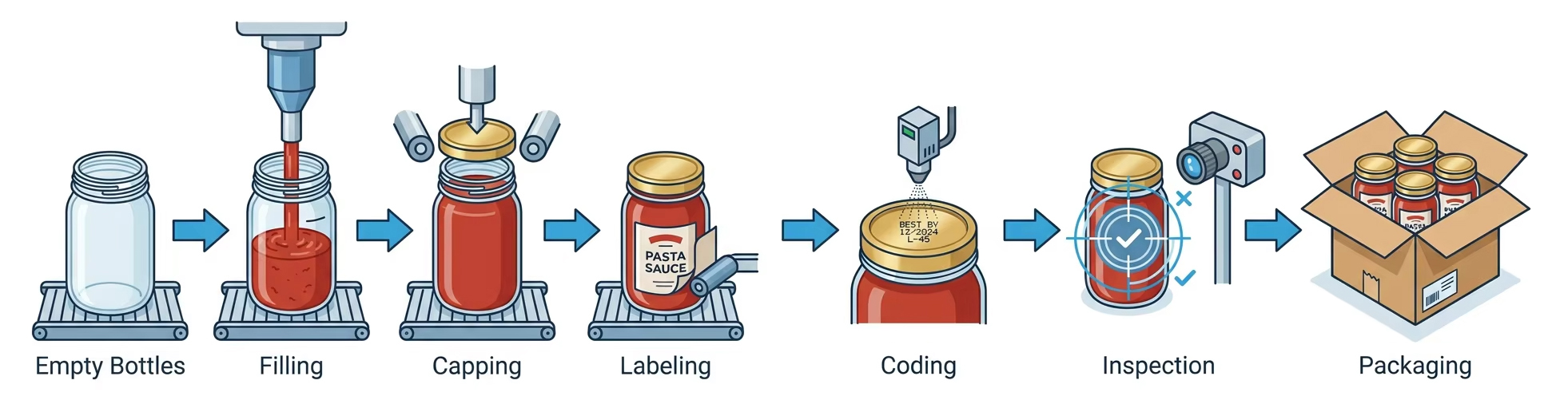
The exact configuration depends on the product being filled, production capacity, bottle design, hygiene requirements, and automation level.
Essential Components of a Complete Liquid Filling Line
1. Bottle Unscrambler
The production process begins with the bottle unscrambler.
Instead of manually placing empty bottles onto the conveyor, a bottle unscrambler automatically arranges bottles into the correct orientation before feeding them into the production line.
Benefits:
• Reduces manual labor
• Ensures continuous bottle supply
• Prevents production interruptions
• Suitable for PET, HDPE, and plastic bottles
• Supports various bottle shapes and sizes
For medium and high speed production lines, a bottle unscrambler significantly improves overall efficiency.
2. Bottle Washing Machine (Optional)
Not every product requires bottle cleaning, but industries with strict hygiene standards often include this step.
Bottle washing systems remove dust, particles, or contaminants that may enter empty bottles during storage or transportation.
Cleaning methods include:
• Air blowing
• Ionized air cleaning
• Purified water rinsing
• Sterile water washing
Common applications include:
• Drinking water
• Juice
• Dairy products
• Pharmaceutical syrups
• Cosmetic lotions
Adding a bottle washer helps ensure product safety and compliance with industry regulations.
3. Liquid Filling Machine
The liquid filling machine is the heart of the entire production line.
Selecting the correct filling technology depends primarily on product viscosity, foaming characteristics, filling accuracy requirements, and production speed.
Common Filling Technologies
Gravity Filling
Suitable for:
• Drinking water
• Juice
• Vinegar
• Alcohol
Advantages:
• Simple structure
• High speed
• Cost effective
Piston Filling
Ideal for medium to high viscosity products such as:
• Sauce
• Honey
• Ketchup
• Cream
• Shampoo
Advantages:
• High accuracy
• Handles viscous liquids
• Easy volume adjustment
Servo Pump Filling
Recommended for:
• Cosmetic creams
• Lotion
• Essential oils
• Pharmaceutical liquids
Advantages:
• Excellent filling precision
• Flexible parameter adjustment
• Stable performance
Flow Meter Filling
Best suited for:
• Cooking oil
• Lubricating oil
• Large volume liquid filling
Advantages:
• Extremely accurate
• Suitable for large containers
• Minimal product waste
4. Cap Feeding System
After filling, bottles move to the automatic cap feeding system.
This equipment automatically sorts, orients, and delivers caps to the capping machine, eliminating manual placement.
Benefits include:
• Continuous cap supply
• Reduced labor costs
• Improved production efficiency
• Fewer misplaced caps
Cap feeders are available for screw caps, flip-top caps, trigger caps, pump caps, and many custom closures.
5. Capping Machine
The capping machine securely seals each filled bottle to prevent leakage during storage and transportation.
Different cap types require different capping technologies.
Common capping solutions include:
• Screw cap capping
• Press cap capping
• ROPP cap sealing
• Pump cap tightening
• Trigger spray capping
• Child-resistant cap capping
Modern servo controlled capping machines provide stable torque control, ensuring every bottle is consistently sealed without damaging caps or bottles.
6. Labeling Machine
Labels are essential for branding, compliance, and product identification.
A labeling machine automatically applies labels with high precision while maintaining production speed.
Common labeling systems include:
• Round bottle labeling
• Front and back labeling
• Double side labeling
• Wrap around labeling
• Top labeling
• Sleeve labeling
Advanced vision positioning systems can further improve label placement accuracy.
7. Inkjet Coding Machine
Most products require production information to be printed directly onto the bottle or label.
Typical printed information includes:
• Production date
• Expiration date
• Batch number
• QR code
• Barcode
Inkjet coding systems improve product traceability and help manufacturers comply with food and pharmaceutical regulations.
8. Inspection System (Optional)
Modern production lines increasingly incorporate automatic inspection systems to reduce defects.
Common inspection functions include:
Vision Inspection
Detects:
• Missing labels
• Incorrect labels
• Crooked labels
• Bottle appearance defects
Check Weigher
Verifies that every bottle meets the required filling weight.
Cap Inspection
Detects:
• Missing caps
• Loose caps
• Incorrect cap placement
Leak Detection
Ensures bottles remain leak free before packaging.
These systems reduce quality issues while minimizing customer complaints and product recalls.
9. Secondary Packaging Equipment
After inspection, finished bottles move to secondary packaging.
Depending on customer requirements, packaging equipment may include:
• Cartoning machines
• Case packers
• Shrink wrapping machines
• Robotic palletizers
• Automatic pallet wrapping systems
These machines prepare products for storage and transportation while improving warehouse efficiency.
How Does a Liquid Filling Line Work?
Although equipment configurations vary, the overall workflow remains similar.
Step 1: Bottle Feeding
Empty bottles are automatically arranged and transferred to the conveyor by the bottle unscrambler.
Step 2: Bottle Cleaning
If required, bottles are cleaned using air or water to remove contaminants.
Step 3: Liquid Filling
The filling machine accurately dispenses the preset volume into each bottle.
Step 4: Cap Feeding
Caps are automatically sorted and supplied to the capping station.
Step 5: Bottle Capping
The capping machine securely seals every bottle.
Step 6: Labeling
Labels are automatically applied according to bottle position.
Step 7: Date Coding
Production dates and batch information are printed.
Step 8: Quality Inspection
Optional inspection equipment checks filling level, labels, caps, and product quality.
Step 9: Final Packaging
Products are packed into cartons or shrink wrapped before palletizing.
How to Choose the Right Liquid Filling Line
Selecting the appropriate bottling line involves more than comparing machine prices. Several factors directly influence performance, efficiency, and return on investment.
Product Characteristics
The first consideration is the liquid itself.
Low viscosity products such as water, juice, alcohol, and vinegar require different filling technologies than thick products like honey, shampoo, sauces, or lotions. Foaming liquids and corrosive chemicals may also require specialized filling systems and compatible materials.
Bottle Type
Bottle material and design affect equipment selection.
A complete filling line can be configured for:
• PET bottles
• Glass bottles
• HDPE containers
• Metal cans
• Custom shaped containers
Machines should support quick changeovers if multiple bottle sizes are used.
Production Capacity
Determine your expected hourly output before choosing equipment.
Typical production capacities include:
• 500 Bottles/Hour
• 2,000 Bottles/Hour
• 6,000 Bottles/Hour
• 12,000 Bottles/Hour or higher
Choosing a line that matches both current production and future expansion plans helps maximize long term investment value.
Filling Accuracy
For premium products and regulated industries, filling accuracy is especially important.
Servo driven filling systems can deliver highly consistent volumes while minimizing product waste.
Automation Level
Manufacturers can choose between:
• Semi-automatic filling lines
• Fully automatic production lines
Fully automatic systems reduce labor costs, improve consistency, and support continuous operation, making them ideal for medium to large scale production.
Future Expansion
A well-designed filling line should be scalable.
Many manufacturers later choose to add:
• More filling heads
• Additional labeling stations
• Vision inspection systems
• Robotic palletizers
• Automated warehouse integration
Planning for future upgrades during the initial equipment selection can save significant costs later.
Industries That Commonly Use Liquid Filling Lines
Complete liquid filling lines are widely used across many industries.
Industry
Typical Products
Beverage
Water, Juice, Tea, Milk
Food
Cooking Oil, Sauce, Vinegar, Honey
Cosmetics
Shampoo, Lotion, Facial Cleanser
Household Chemicals
Detrogent, Bleach, Cleaner
Pharmaceutical
Syrup, Oral Solution, Disinfectant
Lubricants
Engine Oil, Gear Oil
Agricultural Chemicals
Liquid Fertilizer, Pesticides
Because each industry has different hygiene standards, production capacities, and packaging requirements, liquid filling lines are typically customized to suit the specific application.
Frequently Asked Questions
1.Can one liquid filling line handle different bottle sizes?
Yes. Most liquid filling lines can be adjusted to accommodate multiple bottle sizes. For larger differences in bottle dimensions, certain change parts may be required to ensure stable conveying, accurate filling, and reliable capping.
2.Can one filling machine fill different liquid products?
In many cases, yes. However, the filling technology should be suitable for the product's viscosity, foaming characteristics, and filling accuracy requirements.
3.What filling accuracy can be achieved?
Modern servo controlled filling machines typically provide excellent filling consistency, helping reduce product waste and improve quality.
4.Is a bottle washing machine always necessary?
No. Bottle washing systems are generally recommended for industries with strict hygiene requirements, such as food, beverages, pharmaceuticals, and cosmetics.
5.Can a production line be customized?
Absolutely. Equipment can be customized according to bottle type, product characteristics, production speed, factory layout, and future expansion plans.
6.How much factory space is required?
The required space depends on the equipment configuration, production capacity, and packaging process. A professional supplier can design a layout that maximizes the available factory space.
Why Choose Soonfer Machinery?
At Soonfer Machinery, we understand that every production line is unique. Rather than offering one-size-fits-all equipment, we provide customized liquid filling solutions designed around your products, packaging requirements, and production goals.
Our engineering team supports customers from initial consultation through equipment design, manufacturing, installation, commissioning, and after-sales service. Whether you need a compact filling system for a growing business or a fully automatic high speed production line, we deliver reliable solutions built for long term performance.
Our advantages include:
• Customized liquid filling line solutions
• Experienced engineering and technical support
• High quality components from trusted suppliers
• Stable filling accuracy and reliable machine performance
• Comprehensive installation, training, and after-sales service
• Complete turnkey bottling line projects
Conclusion
A complete liquid filling line is much more than a filling machine. It is a fully integrated production system that combines bottle handling, filling, capping, labeling, coding, inspection, and packaging into one efficient workflow.
Choosing the right equipment configuration not only improves productivity but also enhances product quality, reduces labor costs, and prepares your business for future growth.
If you're planning to build a new bottle filling line or upgrade your existing production equipment, Soonfer Machinery can help. We offer customized liquid filling and packaging solutions tailored to your products, bottle types, production capacity, and factory layout. Contact our team today to discuss your project and receive a professional recommendation for the most efficient and cost effective liquid filling line.



Tel : +8613266347573
Mp : +8613266347573
Email : info@soonfermachinery.com
Unit 03, 5th Floor, Dongcheng Science and Innovation Park, No. 8 Juyuan North Road,, Guicheng Street, Nanhai District, Foshan City, Guangdong Province, China

 Call Us : +8613266347573
 Email : info@soonfermachinery.com